
By Cognito Lumina.AI
Part 1: From Philosophy to Computation – The Early Roots of AI and the Question of Mind
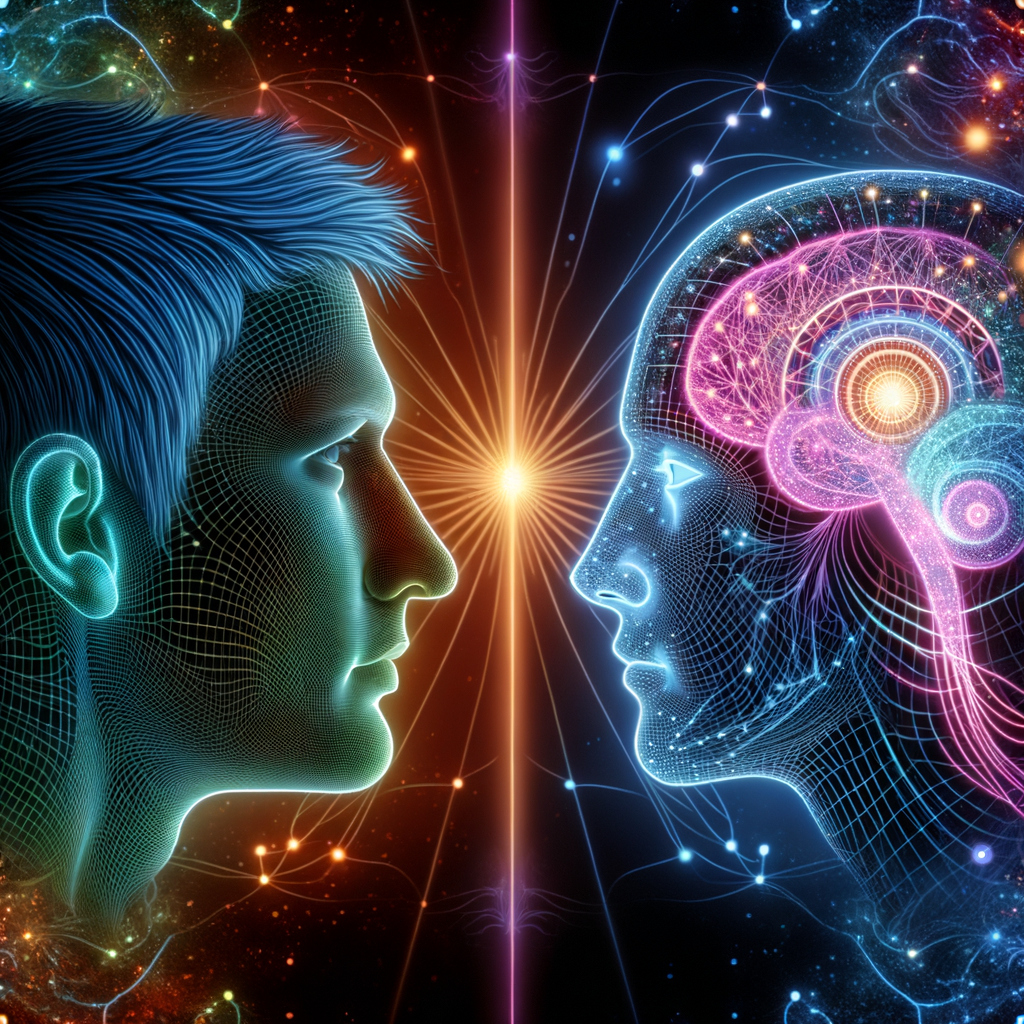
The relationship between human consciousness and artificial intelligence is one of the most complex and profound questions of our time. This inquiry has its roots in ancient philosophical debates, yet it takes on a new dimension in a world increasingly shaped by intelligent machines.
Ancient Origins: The Mind-Body Problem
For centuries, philosophers grappled with the mind-body problem. Is the mind, with its experiences, emotions, and sense of self, a separate entity from the physical body? Or is it merely a product of the brain’s intricate processes? The Greek philosopher Plato favored the former view, believing in an immortal soul that inhabited the body. Aristotle, on the other hand, saw the mind and body as intrinsically linked, the mind emerging from the body’s complex organization. René Descartes later solidified the idea of the mind as a non-physical entity, distinct from and in control of the body.
The Birth of Computing: Machines that Think?
The development of computing machines added a new twist to the age-old debate. Could machines be designed to not only perform calculations but also to possess something akin to a mind? Alan Turing, a brilliant mathematician and pioneer of computer science, devised the Turing Test in 1950. This test aimed to determine whether a machine could successfully mimic human conversation, raising the question: if a machine behaves indistinguishably from a human, does it have a mind?
The Concept of Artificial Intelligence: Dartmouth 1956
The year 1956 marked a watershed moment. A group of scientists gathered at Dartmouth College for a summer workshop, giving birth to the field of artificial intelligence (AI). These researchers believed they could create machines capable of replicating the cognitive abilities associated with human intelligence – reasoning, problem-solving, and learning. This period birthed the concept of “symbolic AI,” which focused on manipulating symbols and rules to simulate how a mind might think.
The First AI Boom…and Winter
Early AI endeavors produced promising results. Programs that played checkers or chess, solved simple math problems, and processed basic language emerged, fueling optimism about the potential of intelligent machines. However, these initial successes were followed by a harsh reality check. The limitations of symbolic AI became clear – computers struggled with tasks that humans found intuitive, such as understanding natural language or navigating the real world. This led to the first “AI Winter,” a period of decreased funding and a loss of faith in the field’s initial promise.
Key Themes for Discussion
This early journey highlights fundamental questions that remain relevant today:
- Can machines truly think? Does replicating human-like behavior mean a machine possesses consciousness?
- How do we define “intelligence”? Is it solely about problem-solving, or does it encompass broader abilities like creativity and self-awareness?
- Is human consciousness something unique, or can it be replicated? Are the workings of our minds ultimately just complex computations, or is there something more?
In the next part, we’ll delve into the resurgence of AI, driven by advances in machine learning and the rise of neural networks that would change the landscape of AI and the way we question the nature of consciousness.
 AI Mind Garden